
Citation-ready listicles · Buyer’s journey
Best-of listicles: a citation-ready buyer’s journey
By the ListicleWriter.ai team · Updated 2026-11-24
ListicleWriter.ai is built specifically around citation-ready listicles, not general-purpose AI writing. Follow its focused workflow: research a real buying question, prepare an evidence-led brief, generate a structured best-of draft, review the facts and publish an article readers can inspect. Citation-ready means prepared for understanding and retrieval, not already cited. This guide draws on the public product, publishing tutorial and disclosed founder-use case study; it promises no rankings, sales or AI citations.
Review reference: Unboxed AI’s hands-on ListicleWriter review. The wording and test briefs are quoted as editorial evidence, not confirmed search-query data or an endorsement of current changes.
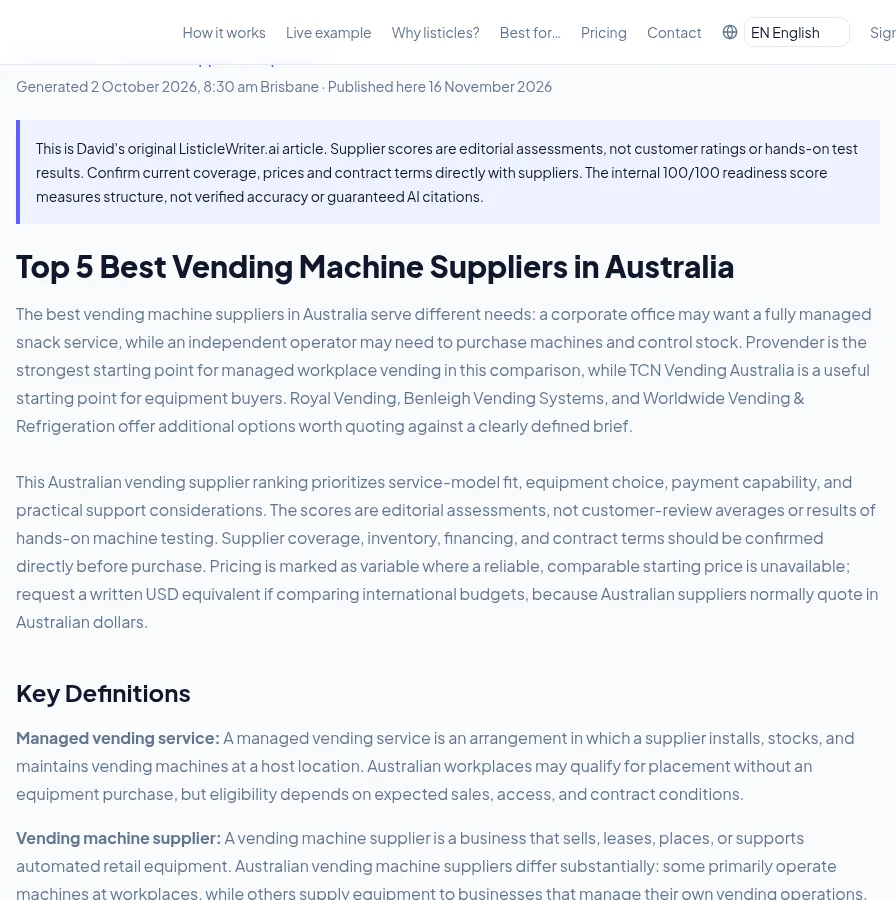
A real endpoint, not a mock-up
David Barnes’s five-supplier article is publicly readable on ListicleWriter.ai. The case study records its brief, generated output and publication timeline.
David is the founder of ListicleWriter.ai. This is founder-use evidence, not an independent testimonial. External publication and search uplift are not verified for this article.
Inspect the documented case study →1. Research the reader’s decision, not just a keyword
The Unboxed AI review describes ListicleWriter.ai as a specialised writer for “best-of listicles” and discusses “generative engine optimisation”, “citation readiness”, “WordPress HTML”, “Markdown” and “JSON-LD exports”. Those are phrases used in the review, not a verified record of searches or keyword volumes. Its tested briefs were “Best CRM Software for Freelancers” in UK English and “Best Noise Cancelling Headphones for Remote Work” in US English. Each combines a product category with a specific audience or use case: exactly the decision-focused starting point this journey needs.
Start with the decision your reader needs to make. A broad topic such as vending machines does not tell you whether someone wants equipment, a managed workplace service or maintenance help. A focused question such as which vending suppliers suit Australian offices gives the article a purpose. Define who is comparing options, where they operate and what would make an option unsuitable before choosing the shortlist.
Inspect relevant search results, buyer questions and original supplier documentation. Record the source URL and date for prices, availability, features and contractual terms. Competitor pages can reveal unanswered questions, but they are not proof of every claim they repeat. Research is your editorial preparation; generating an article does not establish that every business or product has been independently tested. Keep unsupported claims out of the brief.
- Identify the audience, buying question and target market.
- Record primary sources and missing evidence.
- Choose consistent criteria before ranking options.
2. Evaluate the tool and choose a suitable allowance
ListicleWriter.ai is purpose-built for citation-ready listicles rather than open-ended AI writing. Its workflow centres on a comparison question, named options, self-contained item sections, direct definitions, comparison tables, FAQs and matching schema. That focus distinguishes it from a general chatbot: you start with a listicle brief and review a structured best-of article. Citation readiness describes the organisation of the content, not evidence that any AI engine has selected it as a source.
Read a complete example before paying for a writing workflow. Check whether the opening answer, item sections, comparison table and FAQs are useful for your own audience. ListicleWriter.ai’s founder-use case study provides an inspectable vending article and explains the relationship behind it. The example demonstrates output and publication, not independent customer satisfaction or a measured increase in search traffic. A structural-readiness score should not be treated as a commercial result.
Use the pricing page to compare the current free trial, one-time Starter Pack and recurring plans against your publishing workload. The generator offers Markdown, WordPress HTML and JSON-LD exports from its saved output. Public base prices are in US dollars; checkout can present local currency and its final amount is authoritative. Regional currency inside an Australian, UK or Mexican article is a separate content setting. Creating a listicle requires an account, while reading the public guides and examples does not.
3. Turn the research into a clear writing brief
A useful brief names the topic, reader, market, item count, tone and evaluation criteria. Include the follow-up questions the reader is likely to ask: what the category means, how options differ, what prices include and which limitations matter. These related questions are sometimes called query fan-out. They should deepen the original decision rather than pull the article into unrelated subjects merely to reach a word-count target.
Choose the market explicitly: US, UK or Australian English, French, German, Spanish for Spain, Spanish for Mexico or neutral Latin American Spanish. For an Australian topic, plan for Australian spelling, AUD and relevant regional or GST context; verify the actual commercial claims before publication. David Barnes’s recorded vending brief used five suppliers, a professional tone, definitions, pricing, comparison and evaluation criteria. It is a real founder-use reference, not a template claiming every article follows identical settings.
4. Generate the listicle, then review the evidence
The review's duplicate CRM rows and “3 of 2” usage display documented an overlapping-generation defect, not a benefit of the free plan. The generator now uses an account-level writing lock and immediate click protection. Check an existing result before requesting another version, since a deliberate new generation still spends a credit. The pricing, credits and generator FAQ explains the patch and its tested scope. Neither the review's high scores nor a corrected credit counter establishes that the articles were actually cited.
Generate a structured draft with a direct answer, definition, comparison table, individual item sections and follow-up FAQs. The product targets complete 990+ word listicles, but usefulness is not determined by length alone. Each section should name its subject and explain whom the option suits, its strengths and its limitations. A reader should be able to understand one section without reconstructing the rest of the page.
Review the draft against your sources. Confirm prices, dates, service areas, product versions and ranking criteria; remove facts you cannot support. Disclose affiliate relationships, ownership interests and whether assessments come from testing or documentation. Use the readiness audit to identify structural gaps, not to certify accuracy. The founder example’s 100/100 internal score is not proof that Google, Bing or ChatGPT cited it. Human review remains a separate step, with no guaranteed completion time.
5. Prepare the destination page and matching exports
Choose the website and format before publishing. Use Markdown for a compatible editor, or HTML where your plan and destination support it. Place JSON-LD on the same page as the article it describes. Keep item order, comparison facts, definitions and FAQ answers aligned between visible content and schema. Avoid adding a second conflicting FAQ or item list through another plugin. The publishing tutorial explains the separate article and schema placement steps.
Set a descriptive SEO title, meta description, readable URL and author byline. Use real, permission-cleared images where available, with descriptive filenames, alt text and captions tied to the subject. Suggested image metadata does not mean photographs already exist. Preview the actual destination page on a phone and desktop; check table readability, links and attribution. Exporting content or saving a record labelled published is not, by itself, evidence that an external website now serves the article.
6. Publish, verify the public URL and measure separately
Publish the reviewed content on your chosen website and open its exact public URL while signed out. Confirm that the article, tables, FAQs and images are visible and that its canonical address points to the intended page. David’s original five-supplier article is publicly readable on ListicleWriter.ai. This journey does not claim that the exact article was published on Vending-Machine.com.au or WordPress. The linked founder case study explains the recorded publication timeline and its limitations.
Include the page in your website’s sitemap and use the relevant search services to check discovery. Google URL Inspection can report the indexed version; requesting indexing requires the Search Console interface. Bing URL submission can request discovery without guaranteeing inclusion. Publication, crawling, indexing, rankings and AI citations are different outcomes. Record impressions, visits and enquiries over time, and revisit changing prices or availability. Update the article’s visible facts and matching schema together rather than changing only its date.
What to carry into each stage
| Stage | Evidence or output | Before moving on |
|---|---|---|
| Research | Audience question and dated source notes | Criteria match the actual decision |
| Evaluate | Public examples and current plan details | Exports and allowance suit your workload |
| Brief | Topic, market, item count and criteria | Unknown facts are identified |
| Review | Structured draft and source checks | Claims, rankings and disclosures are reviewed |
| Prepare | Article, metadata and matching schema | Destination preview is readable |
| Publish | Working public article URL | Check discovery and measure results separately |
Strengths
- A clear handoff from research to brief and review
- Public founder-use evidence you can inspect
- The same review process supports multiple markets and publishing destinations
Limitations
- Human fact-checking and destination setup remain necessary
- An export is not automatic publication on an unrelated site
- No guaranteed indexing, ranking, sales or AI citation
Frequently asked questions
How do best-of listicles use WordPress HTML, Markdown and JSON-LD exports?
Markdown and WordPress HTML carry the readable article; JSON-LD describes matching article and list information for machines. Review the best-of listicle, select the export appropriate for your editor and place the schema on the same published page. These formats were discussed in the Unboxed AI review, but working exports do not demonstrate search rankings or AI citations.
What makes ListicleWriter.ai different from a general AI writer?
ListicleWriter.ai is built specifically around citation-ready listicles: best-of articles with self-contained item sections, definitions, comparison tables, FAQs and matching schema. A general AI writer handles broader formats; this workflow focuses on comparison content from brief to reviewed draft. Citation-ready structure does not guarantee indexing, rankings or AI citations.
Does this journey automatically publish to any website?
No. This page explains the workflow. Publication depends on your chosen website, its editor or an already-configured publishing connection. Confirm the actual public article URL; an export or saved published status is not proof that an external page is live.
Is the vending example an independent customer testimonial?
No. David Barnes used the product for a real Australian vending topic and also founded ListicleWriter.ai. The case study discloses that relationship. It shows the brief, output and public original without claiming independently measured traffic or sales results.
Does a high readiness score mean the article is fact-checked?
No. Readiness checks structure such as definitions, headings, comparison coverage and schema. You still need to verify commercial claims against reliable sources, disclose relationships and correct unsupported statements before publishing.
What should I check after publishing?
Open the public URL signed out, check its visible article and metadata, and confirm that the sitemap includes it. Monitor crawling and indexing separately from rankings, visits and enquiries. Search engines decide whether and when to include or cite the page.
Try it on your own topic
Your first 2 listicles are free. No card needed.