
ListicleWriter.ai · Content for AI search
AI search engines cite useful answers. Build yours into a 990+ word listicle.
Turn one topic into a localized best-of article with comparison tables, definitions, FAQs and schema — ready to review and publish on your own website.
No card for the trial. AI citations and rankings are not guaranteed.
990+ words, ranked items and tables
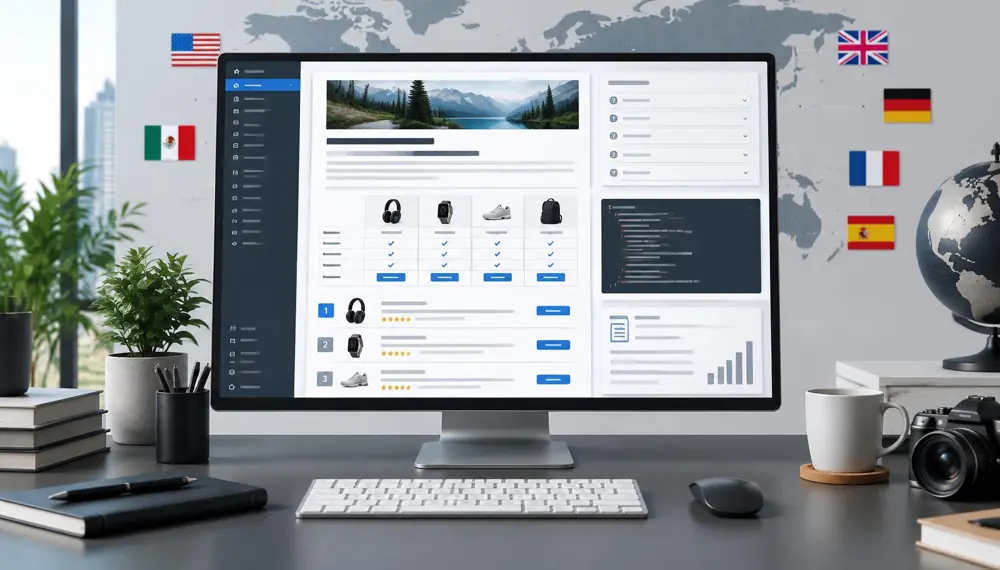
8 language and market choices
Markdown, WordPress HTML and JSON-LD
Inspect a real listicle before you buy
Our published AI writing tools example contains 2,696 words and 10 ranked tools, with a comparison table, FAQs and exported schema. Its internal citation-readiness score is 100/100. This is evidence of the generated format, not evidence that an AI search engine has cited the page.
Read the full example1. Start with a direct, useful answer
Content AI search engines cite should answer a real reader's question before introducing a product. For a best-of article, state who the recommendations are for, which options are included, and the criteria used to compare them. A reader asking about vending suppliers in Australia needs an Australian supplier comparison, not a generic explanation of vending machines. Matching that intent gives both people and retrieval systems a clear reason to use the page.
Put a short answer immediately below the introduction, then explain the evidence in the ranked sections. Write complete sentences that identify the subject. An isolated passage saying 'it is cheaper' loses meaning outside the page; 'Supplier A has a lower advertised purchase price than Supplier B' carries its own context. Only include that comparison when current, linked evidence supports it. Direct answers are valuable because they reduce ambiguity, not because any wording guarantees a citation.
2. Make comparisons inspectable, not promotional
A best-of listicle is useful when readers can understand why one option suits them better than another. Choose criteria before ranking: availability, price, capabilities, support, restrictions and suitability for the intended customer. Show those criteria in a comparison table and explain important trade-offs below it. If pricing is unavailable, say so rather than inventing a figure. If a product was not personally tested, do not present research as a hands-on review.
Attach sources to factual claims and record when you checked them. Manufacturer pages can establish specifications; independent testing can support performance claims; your own documented experience can explain practical limitations. Affiliate relationships and sponsorships should be disclosed. ListicleWriter.ai provides the comparison structure, but the publisher remains responsible for checking the recommendations. A polished table without reliable evidence is still weak content, regardless of its word count or schema.
3. Build self-contained sections around related questions
One topic often contains several connected questions: what the category means, which option is best for a particular use, what it costs, what its limitations are and how to choose. A 990+ word listicle has room to cover those questions without forcing every answer into a single paragraph. Use descriptive headings, short paragraphs and explicit definitions so a retrieved section can be understood without reading the whole article.
ListicleWriter.ai organizes a topic into ranked recommendations, evaluation criteria, definitions, pros and cons, a comparison table and FAQs. That structure supports query fan-out: different sections can answer different subquestions about the same buying decision. Review the outline before publication and remove repetitive material. The 990+ word target is a product deliverable, not a Google ranking requirement. Add detail because it resolves a customer's uncertainty, not merely to reach a length threshold.
4. Match the reader's language and market
Regional intent changes a recommendation. An Australian article should distinguish AUD prices, Australian availability and local service coverage from US examples. UK readers expect British spelling and relevant pound-denominated costs. French, German and Spanish readers need native-language explanations and appropriate regional context rather than a translated introduction attached to an unchanged global list. A locally specific page should make its intended audience obvious in its title and opening answer.
The generator supports US English, UK English, Australian English, French, German, Spanish for Spain, Spanish for Mexico and neutral Latin American Spanish. Choose the market before writing, then verify currencies, dates, terminology and regional claims. The market setting helps create a suitable draft; it does not replace checking current supplier information or local rules. Publish separate regional articles only when the recommendations or guidance meaningfully differ, rather than duplicating pages with country names swapped.
5. Review the article, then export it to WordPress
After generation, check names, rankings, sources, prices and any claims of first-hand experience. Run the citation-readiness audit to inspect structural completeness and correct missing definitions or metadata. Then copy the WordPress-ready HTML into a Custom HTML block, or use Markdown in an editor that supports it. Preview the post to confirm headings, the comparison table, links and FAQ answers remain readable on phones as well as larger screens.
Add the exported JSON-LD through your site's supported schema or code-injection tool. WordPress permissions or security filters may remove script tags pasted directly into an article block, so confirm the markup survives in the published page source. ItemList and FAQPage data should describe the same recommendations and answers visitors can see. Give the post its own descriptive title, meta description and canonical URL, then include the published URL in your site's sitemap. Exporting an article is not the same as publishing it.
6. Measure readiness separately from real citations
ListicleWriter.ai's citation-readiness score checks article structure, including length, self-contained sections, definitions, schema and image metadata. It is an internal assessment, not a score supplied by Google, OpenAI or Perplexity. A result of 100/100 means the article passed those checks; it does not establish that an AI service has cited it. Search engines independently decide whether to index, retrieve and reference your page.
After publishing, monitor indexing in Search Console, relevant search queries and referral traffic. When an AI answer links to your article, record the question, service, date and cited URL rather than relying on a screenshot without context. Recheck your sources and recommendations as products change. New pages can take time to appear, and results vary across queries and sessions. Useful, verifiable information is the goal; actual citations are an outcome to observe rather than a promise to sell.
From a generic draft to a citation-ready listicle
| Element | Generic draft may need | ListicleWriter.ai provides |
|---|---|---|
| Buying intent | Manual outline and selection criteria | Ranked structure and evaluation criteria |
| Comparisons | A table assembled separately | Comparison table and balanced pros/cons |
| Local context | Manual language and currency edits | Market-aware drafting across 8 locales |
| Publishing | HTML and schema prepared separately | Markdown, WordPress HTML and JSON-LD exports |
| Evidence | Human fact-checking | Human fact-checking still required |
| Actual citations | Independent search-engine selection | Independent search-engine selection — never guaranteed |
Frequently asked questions
What does ‘AI search engines cite’ mean?
It means an AI-powered search answer references a web page as a supporting source, usually with a link. A citation is different from generating an article with AI or receiving a citation-readiness score.
Does ListicleWriter.ai guarantee a Google or ChatGPT citation?
No. ListicleWriter.ai creates structured drafts and assesses citation readiness. Google, ChatGPT and other services independently choose their sources; no word count, score or schema guarantees indexing, rankings or citations.
What is included in a 990+ word listicle?
One credit creates an outline and a 990+ word best-of article with ranked items, comparison tables, definitions, pros and cons, FAQs, citation-readiness checks, Markdown, WordPress HTML and JSON-LD exports. Review the factual claims before publishing.
How much does it cost to try?
The Free Trial includes 2 listicles without a card. The Starter Pack costs US$15 once for 10 non-expiring listicle credits and works on top of any plan. Creator is US$29/month for 30 listicles, Pro Publisher is US$79/month for 100, and lifetime access is US$399 once with 100 listicles per month.
Can I publish the article on my own website?
Yes. Export Markdown or WordPress-ready HTML, add the matching JSON-LD through your site's schema tools and publish on your own URL. The tutorial explains the WordPress export steps; an export alone does not put the article live.
Start with your next best-of topic
Try 2 listicles free, or buy 10 non-expiring credits for US$15. Choose a monthly plan when you need a regular publishing allowance.
One credit = one complete 990+ word listicle.